International Student Education
International Student Education
1. Educational Mission
Since the Fall Semester of 2022, the College of Chinese Culture & Education at Wenzhou-Kean University has offered a series of required courses in Chinese National Conditions & Culture (CNCC) for undergraduate international students, gradually establishing an integrated curriculum encompassing Chinese language education, Chinese national conditions, and Chinese culture.
Building on the University's distinctive Chinese-American cooperative education model and multicultural learning environment, the CNCC program aims to help international students develop an understanding of China's history and culture, gain insights into contemporary China, strengthen their Chinese language proficiency, and enhance their intercultural communication skills.
The program emphasizes the integration of academic learning and experiential practice. Through classroom instruction, intercultural dialogue, field-based learning, and cultural experiences, students are encouraged to explore and understand China from diverse perspectives and deepen their understanding of Chinese society and culture through authentic learning and real-life experiences.
2. Curriculum Structure and Credit Requirements
The CNCC program adopts a required-credit system for undergraduate international students enrolled from the 2022 cohort onward. Students are required to complete seven courses totaling 22 credits.
The curriculum consists of the following courses:
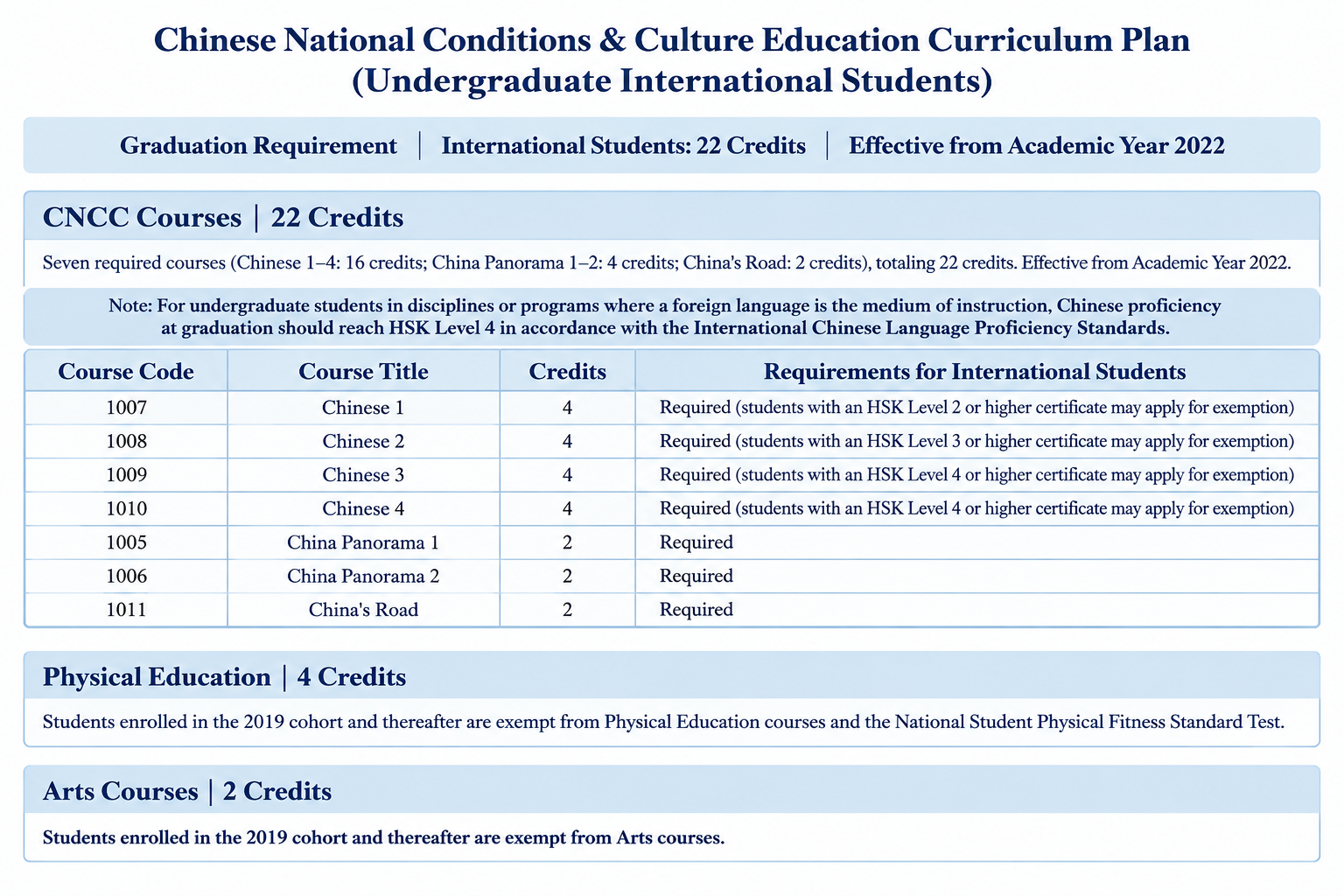
The Chinese language courses focus on developing students' integrated language skills in listening, speaking, reading, and writing, helping them achieve the required levels of Chinese proficiency. Students who meet the University's requirements may apply for course exemptions based on valid results from the Hanyu Shuiping Kaoshi (HSK).
China Panorama 1 and China Panorama 2 introduce students to China's history, geography, philosophy, traditional culture, and contemporary economic and social development. China's Road focuses on China's development process, development path, and related aspects of Chinese national conditions.
Courses on Chinese national conditions are taught primarily in English and incorporate lectures, case studies, thematic discussions, and off-campus experiential learning.
3. Educational Objectives
The international student education program at Wenzhou-Kean University builds on the University's distinctive Chinese-American cooperative education model and multicultural learning environment. With Chinese National Conditions & Culture education at its core, Chinese language development as its foundation, and intercultural understanding and communication as its guiding principles, the program aims to cultivate international students with an informed understanding of China, cultural awareness, and global perspectives.
Through systematic coursework, intercultural dialogue, field-based learning, and cultural experiences, students are encouraged to:
1. Develop an Understanding of China's National Conditions
Gain knowledge of China's history, culture, basic national conditions, social system, and contemporary economic and social development, thereby deepening their understanding of China's development path and social realities.
2. Develop an Appreciation of Chinese Culture
Explore the richness and contemporary significance of China's fine traditional culture, gain insights into Chinese ways of life, cultural traditions, and values, and develop their cultural understanding and appreciation.
3. Enhance Intercultural Communication Skills
Improve their overall Chinese language proficiency, respect cultural diversity, and learn to observe, understand, and communicate across different cultural perspectives, strengthening their ability to engage in intercultural communication and collaboration.
4. Engage in Experiential Learning and Independent Expression
Connect classroom learning with social observation, local cultural experiences, and practical inquiry. Students are encouraged to actively observe and reflect on China and share their learning experiences and perspectives through various forms of expression, including telling China's stories.
Through these educational experiences, international students are expected to develop a more comprehensive and in-depth understanding of China and become active participants in international exchange and cooperation with intercultural understanding, global perspectives, and a sense of social responsibility.
4. Assessment of Learning Outcomes
4.1 Assessment Components
Instructors evaluate students' learning performance based on the following components. Assessment may consist of four elements:
- Class Participation and Assignments (20%–30%)
- Class Discussions, Interaction, and Group Presentations (20%–30%)
- Comprehensive Examinations or Assessments (40%–50%), which may include research papers, investigation reports, or creative assignments.
The weighting of assessment components may vary across CNCC courses according to course content and students' learning needs. The specific assessment requirements and weighting for each course are outlined in the course syllabus for the relevant semester.
4.2 Assessment Methods
Instructors may adjust the specific assessment components and their weighting according to the actual teaching and learning circumstances, while ensuring that continuous and process-based assessment is appropriately implemented.
4.3 Grading Scale
The University's grading scale is as follows:
|
Grade |
Score Range |
|
A |
93–100 |
|
A- |
90–92 |
|
B+ |
86–89 |
|
B |
83–85 |
|
B- |
80–82 |
|
C+ |
76–79 |
|
C |
70–75 |
|
D |
60–69 |
|
F |
Below 60 |
4.4 Important Notes
Course Registration and Withdrawal
- Students who register for a course but do not attend any classes will be treated as having been absent without authorization and will receive a final grade of F.
- Students who fail to withdraw from a course by the deadline specified by the University's Registrar's Office and do not continue attending the course during that semester will be treated as having been absent without authorization and will receive a final grade of F.
Attendance and Leave of Absence
- Students whose unexcused absences or absences due to leave reach or exceed one-third of the total number of class sessions will not be eligible to take the final examination or assessment and will receive a final grade of F.
- Students who are absent with approved leave may submit make-up assignments in accordance with course requirements and retain the corresponding assignment score. However, the attendance score for the missed session will be zero.
- Unexcused absences will be treated as unauthorized absences, and both the assignment score and attendance score for the corresponding session will be zero.
University Email Communication
- University email accounts are the University's official and recognized means of communication with students and an important channel for receiving university announcements and notifications. Students are responsible for checking both their Kean University and Wenzhou-Kean University email accounts regularly.
- If students encounter problems accessing their email accounts or are concerned that they may not have received important messages, they should promptly contact the relevant university offices through appropriate channels. Students are responsible for any consequences arising from their failure to receive or respond to official communications.