
选课随机分组机制说明(自2026级学生起实施)
Clarification on Randomized Course Registration Groups
Effective Starting with the 2026 Cohort
Starting with the 2026 cohort, course registration groups will gradually transition from the current credit-based system to a randomized grouping system. The purpose of this change is to provide fairer and more balanced registration opportunities for students within the same cohort.
1. Who will be affected?
This change applies only to the 2026 cohort and future cohorts.
- Students in the 2026 cohort and later cohorts will be included in the new randomized grouping system.
- Students in the 2025 cohort and earlier cohorts will not be affected and will continue to use the existing credit-based registration grouping system.
2. How Will Students Be Grouped?
Each new cohort will be randomly divided into three registration groups. The number of groups will remain fixed at three throughout the cohort's participation in the randomized registration system.
Students will be randomly assigned to these three groups at designated points, with their registration positions rotating between randomizations according to a predetermined sequence.
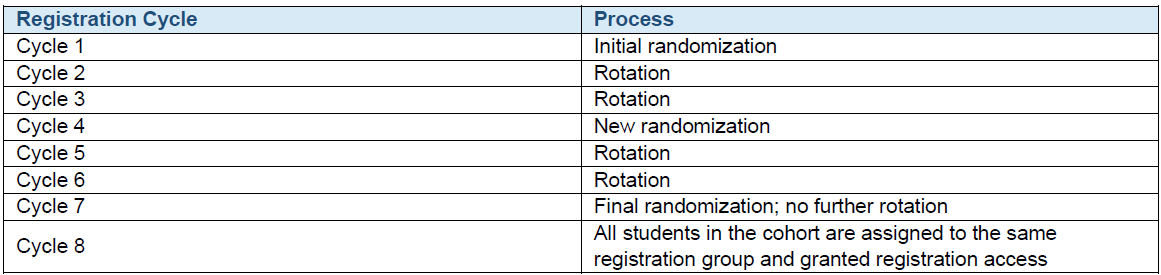
An exception applies to Cycle 8, when all students in the cohort will be assigned to the same registration group and granted registration access. This special arrangement is explained in Section 3.
3. How Do Randomization and Rotation Work?
At designated points, students are randomly assigned to three groups. Between these points, the groups rotate through the available registration positions according to a predetermined sequence. The following tables illustrate how this process works across eight registration cycles.
- Three-Group Rotation
For a cohort divided into three groups, the first three registration cycles follow this pattern:
After Cycle 3, students will be randomly assigned to the three groups again before Cycle 4, and a new three-cycle rotation will begin. The same rotation sequence will apply to Cycles 4–6. Before Cycle 7, students will be randomly assigned to the three groups for the final time. No further rotation will take place after this randomization.
- Registration Process for Cycles 1–8
- Why Is Cycle 8 Different?
All students in the cohort will be granted registration access for Cycle 8. However, the number of students who actually need to register for additional courses is expected to be relatively small at this stage.
Dividing the cohort into three groups would require approximately one and a half days for registration and could delay registration for subsequent groups. Therefore, all students in the cohort will be assigned to the same registration group for Cycle 8, allowing registration to be completed more efficiently while ensuring that all students retain registration access.
4. Why Might My Registration Group Number Change?
The registration group number shown in the system may change from one registration cycle to the next. A change in group number does not necessarily mean that a new randomization has taken place. Students should therefore check the registration group and registration time announced for each cycle rather than assuming that their group number will remain the same throughout their studies.
5. How Will the Transition Take Place?
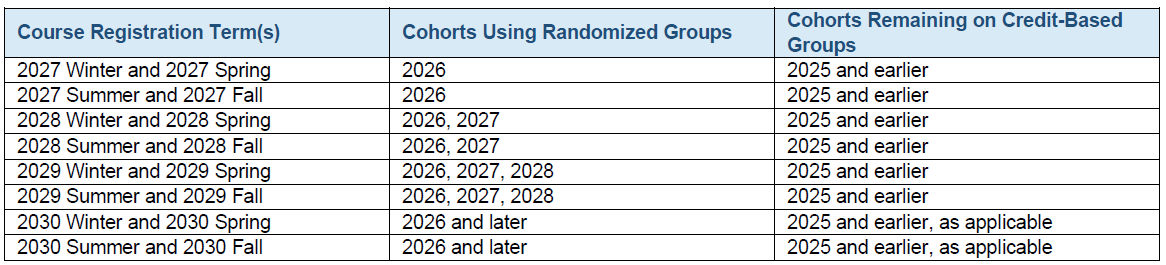
The transition to the randomized system will be implemented gradually, cohort by cohort. Each new cohort will enter the randomized system when it first becomes eligible for the new registration arrangement, while cohorts that entered before 2026 will remain under the credit-based system.
For example, the 2027 cohort will first enter the randomized system when students register for 2028 Winter and Spring courses. Therefore, the 2026 cohort will be the only cohort using randomized groups for registration for 2027 Winter, Spring, Summer, and Fall courses.
6. Why Is This Change Being Made?
- To accommodate the growing number of new students.
As the number of new students continues to increase, maintaining only two registration groups for freshmen would result in group sizes exceeding the system's capacity for each registration period. Dividing students into three groups will allow registration capacity to be distributed more appropriately across groups.
- To establish a consistent registration grouping system.
The new system will gradually establish a unified approach to registration grouping across the University, rather than maintaining two different systems based on earned credits and randomization. For students in the 2026 cohort and later cohorts, the same registration grouping approach will apply throughout their time at the University.
- To encourage more reasonable course planning.
Under the previous credit-based system, students might be motivated to take additional courses or earn extra credits primarily to obtain an earlier registration group. The new system is intended to reduce this incentive and encourage students to register for courses based on their actual academic needs and degree requirements, rather than taking additional courses solely to earn more credits and obtain an earlier registration position.
7. IMPORTANT REMINDER
WKU reserves the right to adjust the randomized registration grouping system if deemed necessary. If any changes are made, students will be notified through updates to this webpage or relevant email communications.
Students should always follow the registration group and registration time announced for each registration cycle.
The Office of the Registrar
October 2026